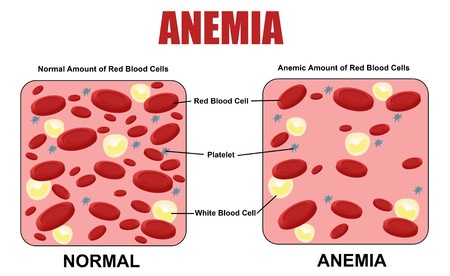

ANEMIA SIGN AND SYMPTOMS

anemia-mental-health

                   Anemia is defined as an abnormally low hemoglobin level, number of circulating red blood cells, or both, resulting in diminished oxygen-carrying capacity of the blood. Anemia usually result from excessive los (i.e., bleeding) or destruction (i.e., hemolysis) of red blood cells or from deficient red blood cell production because of lack of nutritional elements or bone marrow failure.

                    Anemia is not a disease, but an indication of some disease process or alteration in body function. The manifestations of anemia can be grouped into three categories :

  1. Those resulting from tissue hypoxia due to decreased oxygen delivery
  2. Those due to compensatory mechanisms
  3. The signs and symptoms associated with the pathologic process causing anemia.

                     The sign and symptoms of anemia depend on its severity, the rapidity of its development, and the affected person’s age and health status.

Symptoms of anemia.

  • Fatigue
  • Unusually rapid heartbeat
  • Shortness of breath
  • Headache 
  • Difficulty concentrating
  • Dizziness
  • Pale skin
  • Leg cramps
  • Insomnia

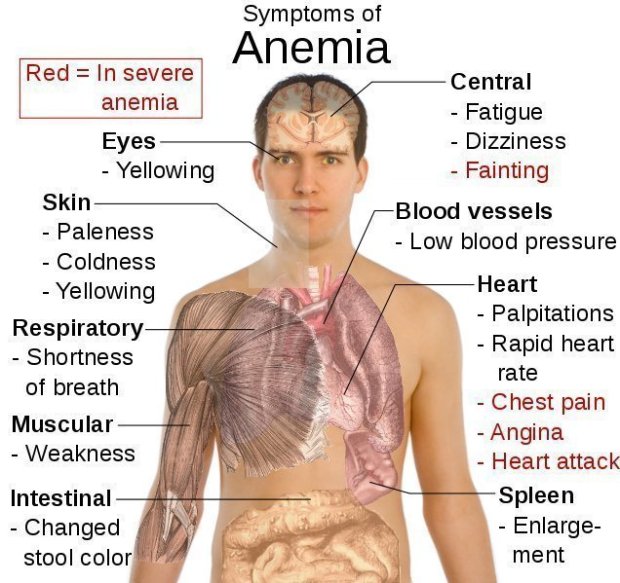
Below is the picture of the summarize of another sign and symptoms of anemia.
symptoms-of-anemia

thank-you-for-reading

thanks_animated


ANEMIAS : Decreased red blood cell (RBC). – Etiology

 Anemia.jpg

The disorder of RBC can be divided into disorders of decreased RBC mass – anemia and those of increase d RBC mass  – erythrocytoses. (This site we will stress on anemias only).

          Anemia is a condition marked by a deficiency of red blood cells or of hemoglobin in the blood. It can be divided into acute and chronic forms. The anemia of acute blood loss, such evident based on complete blood cell count parameters, because losses consist of whole blood and the vascular system contracts on the decreased blood volume. However, with intravascular volume repletion, the erythrocytes will be diluted and the degree of RBC and hemoglobin (Hb) loss will be manifest on the complete blood cell count.

CAUSES

The RBC mass represents the balance between production and destruction or loss of RBCs. Thus, anemia can result from one or more of 3 basic mechanisms:

  • Blood loss
  • Deficient erythropoiesis
  • Excessive hemolysis (RBC destruction)


    ae1b17d0d36777a445b0851c23e206ea.gif

    Blood loss can be acute or chronic. Anemia does not develop until several hours after acute blood loss, when interstitial fluid diffuses into the intravascular space and dilutes the remaining RBC mass. During the first few hours, however, levels of polymorphonuclear granulocytes, platelets, and, in severe hemorrhage, immature WBCs and normoblasts may rise. Chronic blood loss results in anemia if loss is more rapid than can be replaced or, more commonly, if accelerated erythropoiesis depletes body iron stores.

    Deficient erythropoiesis has myriad causes. Complete cessation of erythropoiesis results in a decline in RBCs of about 7 to 10%/wk (1%/day). Impaired erythropoiesis, even if not sufficient to decrease the numbers of RBCs, often causes abnormal RBC size and shape.
    Excessive hemolysis can be caused by intrinsic abnormalities of RBCs or by extrinsic factors, such as the presence of antibodies on their surface, that lead to their early destruction. An enlarged spleen sequesters and destroys RBCs more rapidly than normal. Some causes of hemolysis deform as well as destroy RBCs. Excessive hemolysis does not normally decrease reticulocyte production unless iron or other essential nutrients are depleted.