DIAGNOSIS ANAEMIA

Medical and Family Histories

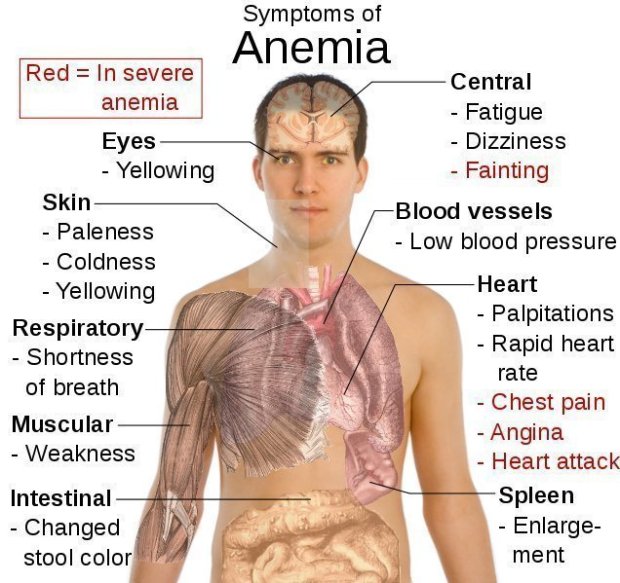
Your doctor may ask whether you have any of the common signs or symptoms of anemia. He or she also may ask whether you’ve had an illness or condition that could cause anemia.

Let your doctor know about any medicines you take, what you typically eat (your diet), and whether you have family members who have anemia or a history of it.

Physical Exam

Your doctor will do a physical exam to find out how severe your anemia is and to check for possible causes. He or she may:

  • Listen to your heart for a rapid or irregular heartbeat
  • Listen to your lungs for rapid or uneven breathing
  • Feel your abdomen to check the size of your liver and spleen

Your doctor also may do a pelvic or rectal exam to check for common sources of blood loss.

Diagnostic Tests and Procedures

You may have various blood tests and other tests or procedures to find out what type of anemia you have and how severe it is.

Complete Blood Count

Often, the first test used to diagnose anemia is a complete blood count (CBC). The CBC measures many parts of your blood.

The test checks your hemoglobin and hematocrit levels. Hemoglobin is the iron-rich protein in red blood cells that carries oxygen to the body. Hematocrit is a measure of how much space red blood cells take up in your blood. A low level of hemoglobin or hematocrit is a sign of anemia.

The normal range of these levels might be lower in certain racial and ethnic populations. Your doctor can explain your test results to you.

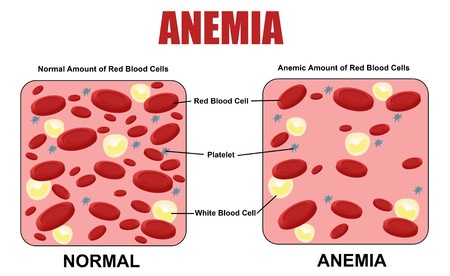
The CBC also checks the number of red blood cells, white blood cells, and platelets in your blood. Abnormal results might be a sign of anemia, another blood disorder, an infection, or another condition.

Finally, the CBC looks at mean corpuscular volume (MCV). MCV is a measure of the average size of your red blood cells and a clue as to the cause of your anemia. In iron-deficiency anemia, for example, red blood cells usually are smaller than normal.

Other Tests and Procedures

If the CBC results show that you have anemia, you may need other tests, such as:

  • Hemoglobin electrophoresis. This test looks at the different types of hemoglobin in your blood. The test can help diagnose the type of anemia you have.
  • A reticulocyte count. This test measures the number of young red blood cells in your blood. The test shows whether your bone marrow is making red blood cells at the correct rate.
  • Tests for the level of iron in your blood and body. These tests include serum iron and serum ferritin tests. Transferrin level and total iron-binding capacity tests also measure iron levels.

Because anemia has many causes, you also might be tested for conditions such as kidney failure, lead poisoning (in children), and vitamin deficiencies (lack of vitamins, such as B12 and folic acid).

If your doctor thinks that you have anemia due to internal bleeding, he or she may suggest several tests to look for the source of the bleeding. A test to check the stool for blood might be done in your doctor’s office or at home. Your doctor can give you a kit to help you get a sample at home. He or she will tell you to bring the sample back to the office or send it to a laboratory.

If blood is found in the stool, you may have other tests to find the source of the bleeding. One such test is endoscopy (en-DOS-ko-pe). For this test, a tube with a tiny camera is used to view the lining of the digestive tract.

Your doctor also may want to do bone marrow tests. These tests show whether your bone marrow is healthy and making enough blood cells.
ERYTHROPOIESIS: FORMATION OF RED BLOOD CELLS

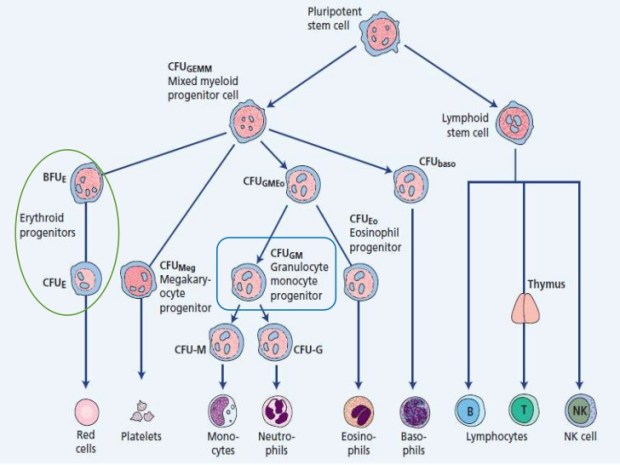
Because of the inability of erythrocytes (red blood cells) to divide to replenish their numbers, the old ruptured cells must be replaced by totally new cells. This short life span necessitates the process erythropoiesis, which is the formation of red blood cells. All blood cells are formed in the bone marrow, the erythrocyte factory, which is soft, highly cellar tissue that fills the internal cavities of bones. The following are the major steps in erythropoiesis. Erythrocytes are derived in the red bone marrow from pluripotent stem cells that give rise to all types of blood cells. Myeloid stem cells are partially differentiated cells that give rise to erythrocyte and several other types of blood cells.erythropoiesis-16-728

Learn something new: Blood cells

WELCOME EVERYONE!

Today we will educate you on blood cells. Anaemia is the disease where a patient has abnormally low counts of blood cells, so it would be best to know about blood cells first.

Our body’s blood is made up of many things we call cells such as red blood cells, white blood cells, platelets (PLATE-lets), and plasma (the fluid -non cell component of blood).

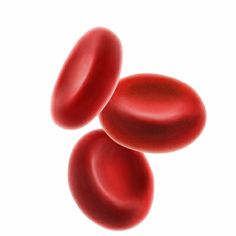
Red blood cells are shaped like a disc and look like doughnuts without holes in the center. Also known as biconcave shape.

They carry oxygen (product body cells need to live) and remove carbon dioxide (a waste product body cells need to excrete) from your body.These cells are made in the bone marrow which is a spongy tissue inside the bones.

anemia2

biconcave disc shape of red blood cells

anemia3.jpg

don’t these red velvet doughnuts look like red blood cells?

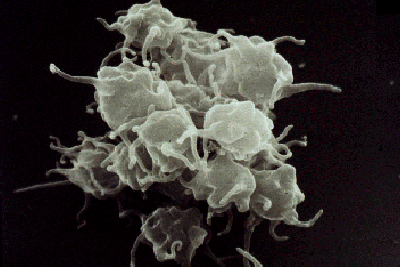
White blood cells and platelets (PLATE-lets) also are made in the bone marrow. White blood cells help fight infection when you are sick. Platelets stick together to seal small cuts or breaks on the blood vessel walls and stop the bleeding.

Image result for white blood cells images

The many types and shapes of white blood cells-each with different functions 

Image result for platelets images

platelets under an electron microscope than can see cells millions of times bigger

Anemia has three main causes:

  • blood loss
  • lack of red blood cell produced
  • high rates of red blood cell destructed

These causes might be the result of diseases genetic conditions or other factors.

HOW TO TREAT ANAEMIA

As we know there are many types of anaemia, therefore the treatment will may vary depends on the types.

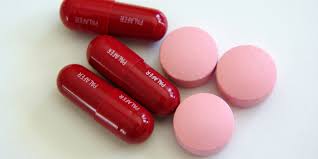
For the anaemia that lack of iron we will treat them with iron supplement or change the lifestyle. For this type of anaemia the source of the problem need to be identified and need surgical if its complicated.

imagesimages-1

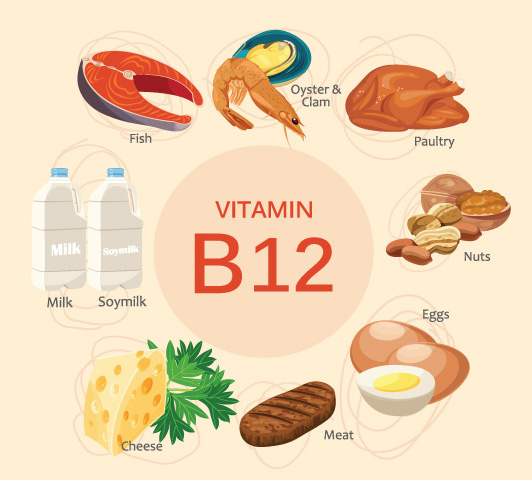
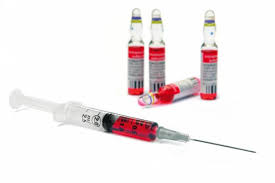
The vitamin deficiency anaemia patient will advised to take vitamin B12 and folic acid in the diet or take the supplement of these. For the people who have trouble in absorbing the vitamin B12 they will given B12 shots. The shots are depends on the situation.

b12

SOURCES OF VITAMIN B12

download

B12 SHOTS

Other treatment that can be done to anaemia patient are blood transfusion and injection of synthetic erythropoeitin to increase the blood volume of the patient. For the people that have the problems with the bone marrow will need bone marrow transplant.

Thats the way in treating the anaemia. Hope this will help you 🙂

ANEMIA SIGN AND SYMPTOMS

anemia-mental-health

                   Anemia is defined as an abnormally low hemoglobin level, number of circulating red blood cells, or both, resulting in diminished oxygen-carrying capacity of the blood. Anemia usually result from excessive los (i.e., bleeding) or destruction (i.e., hemolysis) of red blood cells or from deficient red blood cell production because of lack of nutritional elements or bone marrow failure.

                    Anemia is not a disease, but an indication of some disease process or alteration in body function. The manifestations of anemia can be grouped into three categories :

  1. Those resulting from tissue hypoxia due to decreased oxygen delivery
  2. Those due to compensatory mechanisms
  3. The signs and symptoms associated with the pathologic process causing anemia.

                     The sign and symptoms of anemia depend on its severity, the rapidity of its development, and the affected person’s age and health status.

Symptoms of anemia.

  • Fatigue
  • Unusually rapid heartbeat
  • Shortness of breath
  • Headache 
  • Difficulty concentrating
  • Dizziness
  • Pale skin
  • Leg cramps
  • Insomnia

Below is the picture of the summarize of another sign and symptoms of anemia.

symptoms-of-anemia

thank-you-for-reading

thanks_animated


ANEMIAS : Decreased red blood cell (RBC). – Etiology

 Anemia.jpg

The disorder of RBC can be divided into disorders of decreased RBC mass – anemia and those of increase d RBC mass  – erythrocytoses. (This site we will stress on anemias only).

          Anemia is a condition marked by a deficiency of red blood cells or of hemoglobin in the blood. It can be divided into acute and chronic forms. The anemia of acute blood loss, such evident based on complete blood cell count parameters, because losses consist of whole blood and the vascular system contracts on the decreased blood volume. However, with intravascular volume repletion, the erythrocytes will be diluted and the degree of RBC and hemoglobin (Hb) loss will be manifest on the complete blood cell count.

CAUSES

The RBC mass represents the balance between production and destruction or loss of RBCs. Thus, anemia can result from one or more of 3 basic mechanisms:

  • Blood loss
  • Deficient erythropoiesis
  • Excessive hemolysis (RBC destruction)


    ae1b17d0d36777a445b0851c23e206ea.gif

    Blood loss can be acute or chronic. Anemia does not develop until several hours after acute blood loss, when interstitial fluid diffuses into the intravascular space and dilutes the remaining RBC mass. During the first few hours, however, levels of polymorphonuclear granulocytes, platelets, and, in severe hemorrhage, immature WBCs and normoblasts may rise. Chronic blood loss results in anemia if loss is more rapid than can be replaced or, more commonly, if accelerated erythropoiesis depletes body iron stores.

    Deficient erythropoiesis has myriad causes. Complete cessation of erythropoiesis results in a decline in RBCs of about 7 to 10%/wk (1%/day). Impaired erythropoiesis, even if not sufficient to decrease the numbers of RBCs, often causes abnormal RBC size and shape.
    Excessive hemolysis can be caused by intrinsic abnormalities of RBCs or by extrinsic factors, such as the presence of antibodies on their surface, that lead to their early destruction. An enlarged spleen sequesters and destroys RBCs more rapidly than normal. Some causes of hemolysis deform as well as destroy RBCs. Excessive hemolysis does not normally decrease reticulocyte production unless iron or other essential nutrients are depleted.